Saturday, June 20, 2015

Del Toro's Fantastic 'Robots-versus-Monsters' Epic


Tectonic movement under the Pacific Ocean, creates a fissure, but this is no ordinary fissure, it's a portal, a bridge between our world and another world populated by beings bent on exterminating humanity and taking over earth. To achieve their goal, the hostile alien beings, send gigantic creatures known as Kaiju, to wreak large scale destruction on land. To counter this attack, humanity pools its resources and creates monsters of its own -- equally gigantic robots known as Jaegers, piloted by two people through a neural link, and capable of destroying Kaiju. The battle for earth escalates, culminating in a final confrontation deep under the ocean.

 'Pacific Rim' is a Guillermo del Toro film alright. Long time collaborator Ron Perlman is in it; there are massive, highly unsual creatures in it; it has dimly lit visuals, in which a golden yellow colour tends to appear; it was photographed by long time collaborator Guillermo Navarro; a Catholic rosary appears on screen; there are shots that are so detailed that they have to be seen more than once to be fully appreciated, and so on.


The immensely exciting choreography of the human-to-human and Jaeger-to-Kaiju fights, was a great deal of fun to watch. There was grace, power and clarity. My most favourite Jaeger-to-Kaiju fights are the ones where jaeger Gipsy Danger (piloted by Raleigh Becket [Charlie Hunnam] and Mako Mori [the beautiful Rinko Kikuchi]) goes head-to-head with the Kaiju that I have nicknamed 'Electro-Disabler' and 'Spitter', after Electro-Disabler has disabled jaeger Striker Eureka and destroyed jaeger Cherno Alpha, and Spitter has destroyed jaeger Crimson Typhoon. Ohh maan, both fights are uber-fantastic! The camera briefly focuses on Gipsy Danger's right heel, while she's fighting Electro-Disabler, and we catch a glimpse of the Jaeger mechanics at work -- giant gear-like devices turning, seemingly playng the same role that the achilles tendon does, in the human body. Impressive! If the giant 'articulated' sword that Mako uses to slice Spitter in half, isn't an homage to Voltron, then I don't know what is!


I enjoyed the intense fist-fight between Raleigh and the arrogant Chuck Hansen (Robert Kazinsky), co-pilot of Striker Eureka, who made an offensive  remark towards Raleigh's co-pilot Mako. Raleigh landed some impressive blows. Chuck got a satisfying comeuppance. I also enjoyed the balletic stick fights between the various pilots in (what I will call) the 'Jaeger Corps', whose purpose was to determine 'drift compatibility' -- whether the two participants could pilot a Jaeger together or not. I wondered how this 'drift compatibility' could be determined through stick fighting, and came to the conclusion that that was merely an excuse to include more exciting fight sequences in the film. :)


Charlie Hunnam reminds me of Garrett Hedlund, who played Flynn's son in 'Tron: Legacy'. Both bear a strong resemblance to one another.

I like Raleigh's monologue, at the beginning of this film. It's well-delivered and effectively ushers the viewer into this brilliant fantasy.


The two Scientists -- Gottlieb and Geiszler (played by Ben Gorman and Charlie Day respectively) -- who made up the Research Division of The Resistance, struck me as this film's equivalent of the signal analysts in the first 'Transformers' film -- something to cut to (a filler) when the Jaegers and Kaiju were not on screen. I liked Charlie Day's character but I also found him a little annoying. His high-pitched voice and the hyperactive, sort of ADD nature of his character, were a little annoying.


At first, I couldn't accept the side story that linked the leader of The Resistance, Marshal Stacker Pentecost (Idris Elba), to Mako. It just didn't ring 'true' to me. I just couldn't accept that Pentecost had raised little Mako as his own, after her family had been killed in a Kaiju attack. And that memory of Mako's, where, as a little girl, she's pursued by a Kaiju, that is then killed by a Jaeger piloted by Pentecost, who triumphantly steps out of the 'cockpit' and smiles at Mako, who smiles back in relief -- I couldn't buy that. For me, it lacked 'truth'. But after three viewings, it seems far less implausible.


Another thing that didn't sit well with me in the first viewing, is the sentimentality that precedes the final battle in 'Pacific Rim'. It seemed out of place to me. I'll give two examples. There's the scene where the father-and-son pilots of jaeger Striker Eureka, Herc Hansen (Max Martini) and Chuck Hansen, respectively, have to bid each other a final farewell, as Chuck goes off to help mount a final offensive against the aliens. And the scene in which Pentecost and Mako also have to part, for good. At first I wasn't moved by either of these scenes. But now, I'm starting to appreciate them. I now get moved, somewhat.


I noticed two references to old age, in this film. I wonder if they were of special significance. In the first 'drift initiation' sequence of 'Pacific Rim', brothers Raleigh and Yancy (Diego Klattenhoff), decide who's going to initiate the neural link, and Raleigh jokingly says to his older brother "Age before beauty, old man". And when jaeger Striker Eureka is rendered inoperable by a Kaiju energy burst, and Herc is flung to the far side of the 'cockpit', by the force of a Kaiju blow to Eureka's hull, Chuck rushes to his father's aid, and says "Come on, get on your feet old man!" as he helps Herc up, to which Herc replies, quite annoyedly, "Don't... call me that!".

'Pacific Rim' is an excellent film, a technological marvel. I have never seen anything like this before. This film is a great deal of fun to watch. It's a fitting homage to Monster Masters, Ishiro Honda and Ray Harryhausen. WOW.

Saturday, June 6, 2015

Sissako's 'Timbuktu'


Abderrahmane Sissako's 'Timbuktu' is about the occupation of the titular city by Muslim Jihadists, and the subsequent fight against the invaders and their draconian laws, by the inhabitants of this enchanted place. The story centers on herdsman Kidane, his wife, daughter and adopted son, whose tranquil life is thrown into turmoil, when Kidane accidentally murders a fisherman who has ruthlessly killed his favourite cow, interestingly named GPS, for wandering into his fishing nets, while drinking from a lake.

This film has a lethargic pace and the camera dwells, seemingly pointlessly, on seemingly mundane and inconsequential images. An example is when Kidane has just killed the fisherman. For a long time, both figures lie motionless, partly submerged in water, as if dead. Then Kidane stirs, pries himself from under the lifeless body of his victim, and staggers away, shocked. The camera switches to a long shot, which shows us two tiny figures, one wading across a wide, shallow lake, while the other lies motionless, half-submerged. It stays this way for a long time. I wondered what Sissako was trying to put across. It didn't dawn on me. There's a scene in which a group of young men are playing soccer on a dusty field, without a ball, because the Jihadists have outlawed soccer. They dribble and kick an invisible ball that exists only in their imaginations, and rejoice when they score. It's quite a sight. The players, and camera, actually move as though there is a ball in the scene, when there is none. It's skilfully shot and scored. It's sad.

When Kidane is held prisoner by the Jihadists, for committing murder, he expresses to his captors, that it is not death that he fears, but that he will not see his daughter's beautiful face again. He said this at two or three different occasions. At first, I was moved. And then it started to seem inappropriate. There's a very strange lady in this film, who comes across as a mentally disturbed sorcerer. She walks around dressed in strange garments that drag along the ground behind her, with a live chicken on her shoulder. At one point in the film the camera gazes upon this woman for a long time, as she watches the goings-on around her. I wondered why. I did not see anything of significance within the frame. When one has become accustomed to the machine gun pace that tends to characterize mainstream cinema, it takes some effort to appreciate an unhurried approach. I blame Michael Bay! Just kidding. :)

I laboured through 'Timbuktu', under the starry night sky, in the freezing cold, in the picturesque garden of the Alliance Francaise de Bulawayo. The images of barren, sun-scorched, wind-swept desert, were in direct contrast to the cold, and seemed to alleviate it a little.

P/S: When I was collecting images to accompany this piece, it is only then that it became apparent to me, how beautifully shot 'Timbuktu' is.

Saturday, February 14, 2015

M. Night Shyamalan hits a Home Run!


Before I watched 'After Earth', I read and heard negative reviews of it, so I went in with low expectations... and was pleasantly surprised.

James Newton Howard's score, although not as grandiose as most of his previous work, was quite effective and higly enjoyable. There was some top-notch acting from Will and Jaden Smith, and Sophie Okonedo. Jaden Smith has become a consummate actor at such a tender age -- it's unbelievable, the young man is a brilliant actor. I wonder to what extent, if at all, Jaden (Kitai Raige) drew from his real life relationship with his father Will (Cypher Raige), for the scene in which Kitai berates his father for being a coward who was "never there". Will Smith's performance was quite engaging, despite him being stuck in a single location for almost all of the film. His performance was beautifully subtle and yet rich with emotion. The same goes for Jaden's performance.

I was quite intrigued by the appealingly unusual production design of this beautiful 'coming of age' story. The sets, props, costumes and other elements seemed to me to have been deeply inspired by Mother Nature.The shapes, colours and textures of the clothing, dwellings, vehicles and weapons, all echoed Nature, they were 'organic'. It was this huge homage to Nature, exquisitely combined with cutting-edge imagery and technology. You had these beautifully rendered cutting-edge images, overlaid on or popping out of these very naturalistic, organic-looking devices -- an absolute triumph of design!

Will Smith is a natural fit for the Science-Fiction genre. There's something about seeing him in these imaginary environments, surrounded by all of that super-advanced pseudo-technology, that's just right e.g. 'I, Robot' and 'Independence Day'.

The writing was impeccable. The themes explored -- guilt, fear, coming of age, the nature of reality, self-mastery, the father-son relationship -- held a great deal of resonance for me. At the end of the film, When General Cypher Raige, asks the medics attending to his broken legs, to stand him up so that he can salute his son Kitai, my eyes welled up.

There were echoes of Joseph Kosinski's 'Oblivion' and James Cameron's 'Avatar' in this immensely enjoyable film. I look forward to watching 'After Earth' again... and again.

What did you think of this film? Do you agree or disagree my take? I am curious to know.

Friday, May 3, 2013

Ridley Scott's Somalia


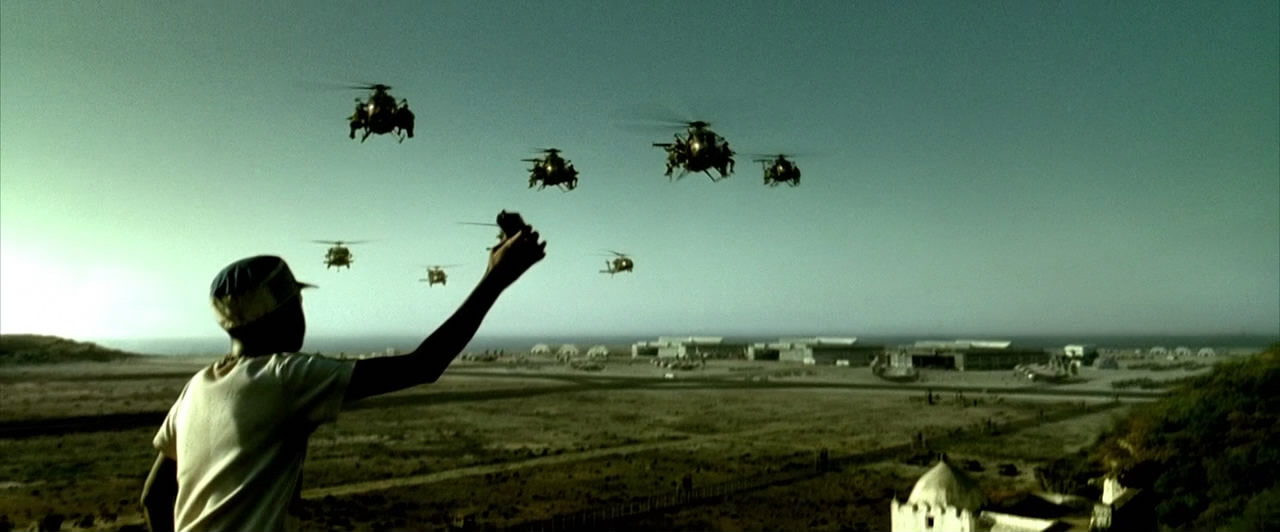
Every time I encounter a Somali person on the bus to or from work, Ridley Scott's 2001 film 'Black Hawk Down', which is set in Somalia, springs to mind. And I wish I had the chutzpah to ask them what life was really like in Somalia, at the height of warlord Mohamed Farrah Aidid's misrule. And what they thought of Scott's cinematic interpretation of Somalia and the events of that Sunday in 1993, when several U.S. army Black Hawk helicopters were shot down in the war-torn capital Mogadishu.


(Images: [top] paintedframe.blogspot.com, [middle] killermovies.com, [bottom] fanpop.com)

Friday, March 15, 2013

Review: Ronny Yu's 'Fearless'


'Fearless' is about real-life early twentieth century Chinese folk hero and martial artist Huo Yuanjia (Jet Li). The film begins in Yuanjia's childhood, when he practices martial arts, behind his disapproving father's back. It is during this time that he has two pivotal experiences: seeing his renowned martial artist father Huo Endi (Collin Chou), seemingly defeated in a fighting contest and experiencing his own defeat at the hands of Zhao Jian (Shang Yapeng), an obnoxious neighbourhood child, shortly afterwards. He swears that he will never be defeated again. As a man, blindly fuelled by these two experiences, and having acquired impressive martial arts skills, he defeats numerous opponents, eventually acquiring the title "Champion of Tianjin".

After Yuanjia hastily fights and kills Chin (Chen Zhihui), the head of a rival martial arts school, who had severely beaten one of his students Liu Zhensheng (Yi Shixiong), Yuanjia's family is butchered in retaliation. Yuanjia goes on to kill… the butcher (Jacky Heung). When he finds out that the cause of all the bloodshed is trivial -- Liu Zhensheng's having a secret love affair with Chin's wife -- Yuanjia leaves Tianjin, grief-stricken and ashamed. He ends up in picturesque rural China, a place that looks like something out of a fairytale, and it is while there, that he finds healing and returns to Tianjin, to right his wrongs.


'Fearless' was beautifully shot, the cinematography was absolutely stunning. It was a feast for the eyes! I enjoyed the rich, vibrant colours and evocative lighting. Of note are the scenes set in the aforementioned picturesque locale, that Yuanjia ends up in. And the images at the end of the film, of Yuanjia gracefully practicing his art, while a magical light illuminates his face and shoulders, against a stark, dark blue background, lending a 'heavenly' quality to the images. Absolutely stunning.

There were hints of 'The Last Samurai' -- a warrior who has gone off the rails, finds his way back to the light, with the help of a beautiful female with whom he has no sexual relations, in a picturesque, somewhat secluded country setting. And Masato Harada, who played Japanese diplomat Omura in 'The Last Samurai', was present as Mr. Mita, also a Japanese diplomat.


There are three qualities that I look for in a screen fight -- grace, power and clarity. The fights in 'Fearless' had all three. They were a pleasure to watch. Fight choreographer Yuen Woo-ping is like the postman -- he always delivers. Although, there's one fight that takes place on a wooden platform elevated very high up from the ground, that was somewhat dodgy. Parts of the fight didn't transition smoothly into each other, it was jerky, as though some footage had been unskilfully excised. And the fight wasn't quite 'natural', the wire-assisted moves were rather too apparent.

I enjoyed the restrained but impactful interactions between Yuanjia and Moon (Betty Sun), the lady who helps him heal. In some instances, Li and Sun conveyed much without speaking, but merely with the look in their eyes. It was beautiful.

I watched 'True Legend' (2010) before I watched 'Fearless' (2006), and so the advantage of hindsight or is it foresight, or both?… came into play. It seemed to me that 'TL', which debuted several years after 'F', was somewhat a retread or remake of 'F'. I find it interesting that both films were scored by the same composer, the talented Shigeru Umebayashi; Yuen Woo-ping choreographed the fights in 'F' and on 'TL', he directed everything, the fights and all other aspects; the theme of re-igniting Chinese pride by trouncing invading foreigners in the 'ring', runs strong in both films; and the set design, in both films, of the area where the bouts take place, is similar. And I wonder if Collin Chou, who played Huo Endi, Yuanjia's father in 'Fearless', is related to Jay Chou, who portrayed the 'god of wushu' in 'True Legend'. If 'True Legend' was intended as a remake of 'Fearless', then the former wins, hands down!

'Fearless' isn't the best entry in its genre, but it's definitely worth a look.

Jiéshù

(Images: blu-ray.com)

Sunday, February 10, 2013

The Dark Knight Rises: Second Impressions


The first time I watched ‘The Dark Knight Rises’, it blew me away. But on watching it for the second time, it didn’t appeal to me as much. I found it far less enjoyable. Was I in a ‘Hollywood-marketing-machine-induced’ euphoria when I watched it the first time? Was the euphoria of my own making? I’m not certain.

The unintelligibly edited hand-to-hand fights, that had held a sliver of appeal for me before, didn’t appeal to me at all, this time. Perhaps Nolan and crew should have hired master fight choreographer Yuen Woo-ping (The Matrix, Fearless, True Legend; Crouching Tiger, Hidden Dragon etc.) and asked him to tone down the awe-inspiring, gravity-defying moves that characterise a great deal of his work! I’m certain that master Yuen, even with his wings clipped to suit Nolan’s ‘realistic’ style, would have done a superb job.

The sound effects and score seemed to drown out the dialogue. Was it a result of poor sound-mixing on the part of the filmmakers? Was it the theatre’s sound system that was faulty? Was it my ears? I don’t know. Although, I doubt very much that it was my ears – they are still in fairly good condition you see. The other two are more probable.

I still don’t know how Selina Kyle (Anne Hathaway) had what seemed to be close ties to Bane (Tom Hardy) or how she knew so much about him. I know that the answers lie in the film’s dialogue – if only so much of it wasn’t so difficult to hear!

The epic scale of ‘The Dark Knight Rises’, demands that one be in awe of this film. Its scale is epic indeed; a marvel. One example is the huge vehicular chase involving Batman as the pursued and almost all of the Gotham Police Department as pursuers.  But I’m currently of the mind that there isn’t that much mass/substance to this colossus of a film. Ah, the epic proportions of this film, the spectacle of it.

In some instances, the film – the moving images – relied too much on the score, to generate excitement, to the point that the score overshadowed the images. The score made grand promises of excitement while the images failed to deliver. An example is when ‘The Bat’ flies the ‘nuclear bomb’ out of Gotham so that the ‘bomb’ detonates out at sea. The music in this sequence is grandiose, but what’s happening on screen isn’t grandiose.

It’s annoying to watch a film that was partly shot on IMAX film and be unable to see, fully, the grandeur of the IMAX shots, because you’re watching the standard-sized print, on a standard-sized screen. Such was the case with ‘The Dark Knight Rises’.

The theatre screen wasn’t large enough to accommodate the whole film image. The film image exceeded the boundaries of the screen, such that part of it could be seen on the area around the screen. That was very annoying. Are movies nowadays being shot in a wider aspect ratio than before? Is it because ‘The Dark Knight Rises’ was shot on a variety of film stock sizes – IMAX, 35mm and I-don’t-quite-remember-what-else. Did the projectionist not know what he was doing? I don’t know.

I don’t think that this film would have been any less enjoyable without Talia al Ghul (Marion Cotillard), Selina Kyle (Anne Hathaway) and Robin John Blake (Joseph Gordon-Levitt). These characters felt a little tacked on. I felt that their presence wasn’t integral to the story. It was as though they had been added at the last minute, when the filmmakers felt that there weren’t enough characters to keep the audience interested. ‘Batman’ films have always been an ensemble piece, after all.

The idea of a prison with a shaft leading up to the surface seemed rather too implausible this time. So were the prisoners chanting the phrase “deshi basara” and a TV installed in prison, especially for Bruce Wayne to witness the destruction of Gotham.

Jo
dhpur, India, which was chosen to represent the landscape outside the prison, because of its ‘desolate look’, didn’t look foreboding to me at all. Instead, it looked beautiful. The rustic colours were absolutely majestic. 

Thursday, August 23, 2012

The Dark Knight Rises: First Impressions


So I watched Christopher Nolan’s cinematic tour de force ‘The Dark Knight Rises’, on the afternoon of 17 August 2012. It was my first visit to the cinema in South Africa. I was expecting the facilities – the actual screening room -- to be far more technologically advanced than what’s available back home, in Zimbabwe, but that wasn’t the case. It was the same, at least in terms of theatre size, screen size and screen structure/mechanics.

A tiny portion of the screen seemed to have been singed off by a naughty patron. During the showing, the picture was slightly out of focus and the sound wasn’t 100% clear. It was slightly ‘muffled’, making it hard to hear the dialogue. The audio output wasn’t ‘multi-channel’ or ‘surround’, it was stereo. Granted not all theatres are equipped with multi-channel audio. And this was one theatre within a multiplex and one branch within the Ster-Kinekor chain. This is hardly reflective of all the cinemas in South Africa, Ster-Kinekor or otherwise. It’s just that I was expecting a gigantic screen; a super-sharp, bright picture and super-clear, multi-channel sound – a top notch experience. This was Ster-kinekor, after all. The seat was the most comfortable cinema seat I’ve sat in thus far, though.

Anyway, the result of the poor sound, was my missing (verbal) narrative points that would have enhanced my understanding of the story and therefore my enjoyment of the film. I could be wrong but, I don’t think that the problem was the particular print or reels, that we were watching, but the playback system – the film projector and related equipment. It’s a little over a month (at time of writing) since ‘The Dark Knight Rises’ had its global theatrical debut, so it’s too soon for the reels to have worn out. Isn’t it, dear reader? Oh! Another thing, the end credits were cut short. I hate that. There are many interesting things that one can discover from watching the end credits roll.

Enough of that.

I am supposed to put forth a synopsis of the film here, but that seems rather redundant, therefore I shall not. Actually, what interests me most about writing film reviews is sharing my thoughts, so I’ll use artistic licence and skip the synopsis.

Hans Zimmer’s score was impressive, as expected. It was dark, epic and immensely beautiful. It added a great deal of impact to the visuals. The dialogue – that which I managed to catch – was good. It was appealingly dense – chockfull of references to past events -- and in some moments insightful, philosophical, thought-provoking, funny and witty. The kind of dialogue I like. I am no film expert, but I didn’t find the cinematography particularly striking. Which isn’t to say that it was bad, it’s just… there isn’t a shot that struck me and made me go “wow, that’s beautiful”. (Writer’s introspection: what’s the point of all this writing about movies again?)

Tom Hardy’s Bane was exceptionally good. Bane stood head and shoulders above everyone else, both literally and figuratively, and stole the show. He was genuinely menacing and there was depth to him. He wasn’t a cardboard villain, he had a back-story that was actually kind of moving. Bane’s speech, which was filtered through his mask, was somewhat hard to decipher, and the poor audio made it harder.

I’m noticing that I usually enjoy more and have more to say about the supporting performances than the lead performance. Anne Hathaway’s Selina Kyle/Catwoman, because I couldn’t make out some of the dialogue, I’m certain I missed things that would have led me to appreciate her more. Because I didn’t understand how she knew so much about Bane, how she could saunter in and out of Bane’s lair/hideout, without being harmed, and yet tell the police (I think it was the police) that they should be as fearful of Bane as much as she. Perhaps I’ve become hard of hearing. Hathaway looked spiffy in a cat-suit but I couldn’t quite make out what was going on in hand-to-hand fight sequences involving her. The hand-to-hand fights in this film, I found generally hard to follow. I think it was Editor Lee Smith’s quick cuts. My current stance is that there really wasn’t much meat to Hathaway’s role, dramatically, but I could be singing a different tune in future. We are such fickle creatures we human beings. But seriously, I’m certain I’ll appreciate her more when I watch a visually and aurally pristine copy of this film.

I felt that Christian Bale’s performance was adequate. Bruce Wayne isn’t an awfully emotive man, he plays his cards close to his chest, and Batman is without emotion, automaton-like, which is as it should be. But that’s what makes it difficult for me to gauge Bale’s performance because it was so restrained – internalized. Taken at face value, one would think that Bale didn’t break much of a sweat in portraying Bruce Wayne/Batman, but nothing could be farther from the truth. I wonder though, how much of Bale’s performance as Batman – underneath the face-concealing cowl – was actually his, considering that it was easy for a stunt-double to play most, if not all, of Batman. I’m just wondering. I felt that Gary Oldman’s, Michael Caine’s, Joseph Gordon-Levitt’s, Marion Cotillard’s, Morgan Freeman’s and Cillian Murphy’s performances, as Commissioner James Gordon, Alfred Pennyworth, Robin John Blake, Miranda Tate, Lucius Fox and Jonathan Crane respectively, were adequate too. The scene towards the end of the film, where Alfred (Caine) weeps at the graves of the Wayne family, feeling that he failed Bruce’s parents, felt contrived and overly sentimental. I wasn’t moved.

The scene where Catwoman leads Batman to Bane’s lair, leading to Batman and Bane having their first meeting and physical confrontation, was disturbing. Because of Bane’s then superior fighting prowess, I genuinely feared for Batman’s life. Bruce’s punches, kicks and fancy gadgets had no effect on Bane. And as Selina Kyle looked on regretfully from above, as Bruce was pummeled almost to death, I was moved. There was a real sense of danger… grave danger, in this scene. That’s testament to the power of cinema. When Bruce valiantly persisted in the face of a then unbeatable force, the futility of it made me deeply sad. But what I liked about the ending of this sequence was that, although Bruce was defeated, his body broke before his spirit -- a good sign, some encouraging subtext from the writers. This film was very well written.

I liked the scene where Gordon, in the presence of Blake, laments the restrictive nature of legal structures in the pursuit of justice and describes the events surrounding Harvey Dent’s death. Gordon’s skillful use of words was impressive – something to do with plunging one’s hands into the filth and so on -- bravo!

The special- and visual-effects in this film were well done. It was thrilling to see Bruce and Selina working together to retrieve the stolen fusion core – the ‘batpod’ racing through the deserted streets, while ‘the bat’ whizzed overhead. The fictional mechanics of both contraptions were impressive – especially the unusual way the wheels of the batpod turned when making a sharp turn. And the ‘rider’s view’ shots when either Batman or Catwoman was riding the batpod, were fun. They gave me a sense of the speed and maneuvering of the bike. There’s a scene where Bruce alighted his vehicle to be met with a barrage of reporters’ camera flashes and questions, and promptly disabled the cameras with an unseen device on his person – nice. I wonder what it was, I’m thinking EMP – electromagnetic pulse burst.

Alfred wanted Bruce to leave Gotham, find himself (another) good woman and live a normal life – this struck a chord with me, because I drew parallels… I was also struck by the simplicity of the sans-serif typeface used for the title of the film. It was just blocky and unadorned – uncharacteristic of big-budget comic book adaptations, which usually have elaborately designed titles; with glows, 3D effects and so on – very ‘Nolan’. The ending was reminiscent of Nolan’s ‘Inception’, with the hint that things aren’t quite what they seem; that there’s more to come.

‘The Dark Knight Rises’ is a solid film. It’s so engaging and well executed, that I didn’t feel the long running time of approximately two hours and forty minutes. I felt that it’d all gone by too quickly instead. It’s moving, thought-provoking, disturbing, funny and spectacular. What appealed more to me were the drama and themes explored, than the action. It was an afternoon well spent. That is, despite the aforementioned technical issues.

I walked out of the theatre feeling as though I was Joseph Gordon Levitt’s character, Blake. I like it when I leave the cinema feeling as though I’m one of the characters in the film I‘ve just watched. It’s one of the ways I know that I’ve enjoyed myself. I’ll be revisiting ‘The Dark Knight Rises’ for a long time to come.